Thursday, January 19, 2012

Opening at Breadworks Tomorrow!

The flyer that Breadworks distributed for my opening in Boulder, Friday, Jan 20, 6-9 p.m.
(click to make bigger)

I'm heading to Boulder this afternoon, despite the "damaging winds" that are gusting there this morning to 75 mph according to the Weather Underground.  I'm hanging my photos at Breadworks tonight in anticipation of the opening tomorrow night, Friday, January 20, from 6-9 p.m., at Breadworks in Boulder.  I hope to see some of my Boulder friends there, but have been warning then that Breadworks is charging $10 to get in.  My feelings won't be hurt if you don't want to pay to go to Breadworks!  You can look at the photos for free some other time.  But...if you do make it, thanks!  I'm looking forward to visiting.

Saturday, January 14, 2012

Show at Breadworks in Boulder

Naan, Kashgar, Xinjiang Province, China (2006).

Beginning next Friday, I am showing photographs at Breadworks, a popular eatery in Boulder, Colorado.  The show will feature work from when I lived in China in 2005-06.  If you live in the Boulder area, I'd love to see you at the opening on Friday night, January 20, from 6-9 p.m. at Breadworks.  They are providing music and food!  If you would like to see more of my China images, you can view them on flickr, my website, and a blog that I wrote while living in Yunnan.

I'll post some more of the work I'll be showing in the next few days.

Tuesday, January 10, 2012

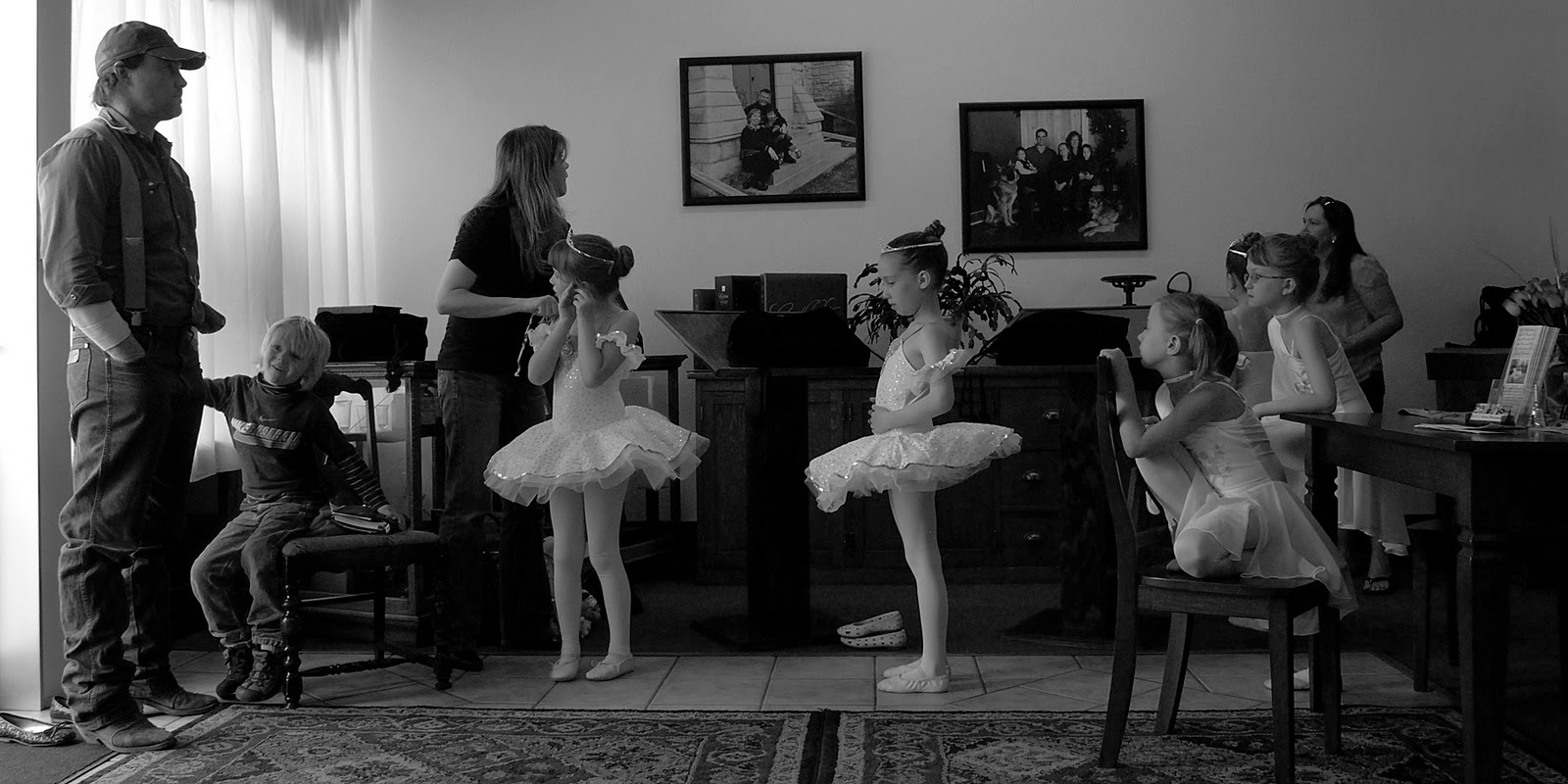
Small town ballet

Ballet students at photo studio, Laramie, Wyoming. May, 2008.
(click photos to make bigger)

Classes started this week at the University of Wyoming.  Since I teach a couple of them, I haven't posted a blog for a few days.  I just completed day one of class and am taking a breather from preparation to look back through older photos.  One of the long-running themes of my Wyoming photo collection is children's dance, since Bei, my daughter, has been participating in it since she was three-years-old.  In fact, when she was three I once had to perform with her in a father-daughter dance;  you can imagine.  

Here in Laramie, we're lucky to have a fantastic dance studio (The Laramie Dance Center), run by Kathy Vreeland, who is a master at corralling hundreds of little girls (and a few boys) into well-organized performances, against all odds.  Each May, her classes march over to one of the photo studios in town for a group photo, and later appear as if by magic on stage at the UW Arts and Sciences Auditorium, in costume and makeup, for themed dances.  It's a logistical feat, no less complex than withdrawing troops from Iraq, in my opinion.

I made the above image while waiting for my daughter's class to get their photo taken.  For me, it's a classic with the little girls in their tutus and the dad in overalls and cowboy boots.  The picture was featured a few years ago on the website of The Candid Frame, which podcasts photography interviews regularly. The interviews, by the way, are great if you are into photography and often so even if you aren't.  

Dancers, May 2008.

The Green Room, May 2009

Bei, makeup, May 2010.

Kathy Vreeland with rescued terrified dancer, May 2011.

Wednesday, January 4, 2012

Abandoned refinery in Laramie


Graffiti at the abandoned Standard/Midwest refinery in West Laramie.

The abandoned and decrepit Standard/Midwest refinery on the West Side of Laramie has always been an interesting place for photographers, graffiti artists, and assorted riff raff (I imagine).  This ruin has been here since it was abandoned about 20 years ago.  According to Laramie's newspaper, The Boomerang, the Laramie Rivers Conservation District is planning to clean up the "ugly and dangerous relic."  I don't really have any ground for arguing that the site isn't dangerous.  Apparently it was a yttrium processing facility at one time and the soils are contaminated, and there are certainly a lot of holes, broken concrete, and rebar throughout.  But ugliness is in the eye of the beholder, and I personally find the site quite appealing visually--it's one of the most interesting places to photograph in town, and quite a lot of fun to explore.  It's hard to say that the site shouldn't be cleaned up, but I'll be sad when it is, truth be told.

An abandoned building at the site.

Concrete ruins, with graffiti.

 More concrete, more graffiti.

A rose by any other name is an "ugly" and dangerous site.

Saturday, December 31, 2011

Wind

Wind.

Wind.

And more wind.  December 31, 2011.

Despite the 70 mph wind gusts, I decided to go out and shoot some photos in the Laramie Basin this morning.  Wind has been the weather story here lately and, for that matter, since the Pleistocene.  But the strength of it was a little above average today, threatening to rip the door off of my truck if I forgot to pay attention and hold on with both hands when I opened it.  My first destination was the Laramie River north of town.  The river is frozen of course, and since we've had no snow to speak of, the ice is clean.  One of these days I'm going to take a pair of ice skates out there and see how far I can go.  But not in this wind. 

On the way back towards town, I saw lots of plastic snared on barbed wire trying hard to escape to follow the wind east, but not having any luck.  Over the years I've made a series of images of plastic stuck in wire, and sometime I'm going to organize them into set of images to show, even if only for myself.

I finished my morning trip exploring the old Standard/Midwest refinery in West Laramie, which will be the subject of another post.  Finally, with frozen hands I headed for home.  It's been a great year and what better way to spend the last day than shooting photos in the Laramie wind? 

I'm not kidding.

Wednesday, December 28, 2011

To Include or not to include? That is the question.

Canyon near Medicine Bow, Wyoming.  May 2008.

Canyon near Medicine Bow, Wyoming, with mattress.  May 2008.

Many of us who become obsessed with photography begin with a love of landscapes.  This is especially true when you live in a place like Wyoming, which is rich in them. I once heard the musician David Bromberg, while playing at the Wort Hotel in Jackson, lament that "too much of Wyoming is out of doors."

We're all aware of famous landscape photographers; Ansel Adams immediately comes to mind and of course there are many others.  Classical landscape photographers and painters studiously omitted any sign of human disturbance, and this tradition continues today among a subset of photographers even as it becomes increasingly difficult to frame a photograph without SOME evidence of humans--either on the ground or in the sky (contrails are almost unavoidable). 

Of course many contemporary landscape photographers have embraced human impacts. Tomorrow I'm going to Denver to see the Robert Adams' photos at the Denver Art Museum. Adams photographed extensively in the West and masterfully depicted the impact of man on landscapes.  In a description of an exhibition of his work at the Getty Museum in L.A., the writers say:

"His work is inspired both by his joy in the inherent beauty of the landscape, and his dismay at its exploitation and degradation for residential and commercial development.

In his images of main streets, tract houses, trees, and waterways, Adams records two kinds of landscapes, one damaged by people and the other somehow beyond their power to harm. He asks us, through his photographs, to consider where we live and how we relate to our environment
."
Closer to home, the photographer Martin Stupich explored the interaction of man with Wyoming's Red Desert. Some of his photographs show untouched landscapes, which can still be found there, while others emphasize human activity--primarily but not exclusively related to oil and gas extraction. 

I just read the excellent The History of Photography by Beaumont Newhall, in which he elegantly traces the evolution of photographers scientifically and artistically from the first experiments with camera obscuras to modern color prints.  He describes the realization that photography has the special power to capture the world as it is, with no embellishment and quotes Oliver Wendall Holmes, speaking in the context of graphic photographs of the American Civil War:
"The very things which an artist would leave out, or render imperfectly, the photograph takes infinite care with, and so renders its illusions perfect."
How many times have I struggled to artificially crop the effects of humans from landscapes, when including them would be both more honest and when their inclusion would make a better photograph?  (Answer: Lots.)  Neither of the photographs at the beginning of this post are spectacular, but which is more interesting?

Saturday, December 24, 2011

Christmas at the Buckhorn Bar

Christmas tree at the Buckhorn.  December 2008.

I haven't had time to write a suitable Christmas post, so here's a photo from the archives--the Buckhorn Bar (Laramie) Christmas tree in 2008.  It probably looks exactly like this in 2011, with the same people at the bar. 

Have a great Christmas!


The Buckhorn, Laramie, 2008.