Showing posts with label Oaxaca. Show all posts

Monday, December 9, 2024

Guadalupe Mountains, Texas and New Mexico

Our Lady of Guadalupe on a wall in Oaxaca, Mexico (2007).
(Click images to view larger)

In 1531, a Mexican peasant named Juan Diego and his uncle, Juan Bernardino, reported seeing several apparitions of the Virgin Mary, a.k.a. the Virgin of Guadalupe and Our Lady of Guadalupe, near Mexico City. Subsequently, depictions of the purported traveling virgin became iconic, and innumerable places throughout Mexico and the Southwestern U.S carry her name. On a recent outing, we visited the Guadalupe Mountains of SE New Mexico and West Texas, a National Park and home to Carlsbad Caverns and it’s Brazilian free-tailed bat population, which had already migrated south for the winter when we were there, leaving only its guano behind. Summer visitors can watch thousands of bats emerge from the cave at dusk and spiral into the night sky.

Mid- to late-November is autumn in West Texas, but fall color doesn't come to mind in the desert, so we were surprised to learn that trailheads would likely be packed with leaf-peepers. After the five-hour drive from Silver City, we walked to Smith Spring, a short hike into the foothills from a historic ranch. A ranger told us that autumn foliage at the spring was spectacular despite peaking a week or so earlier, but we were skeptical as we walked across the Chihuahuan desert towards a dry-looking canyon. But inside the canyon, clear pools of water seeping from a sandstone layer beneath limestone cliffs created a wet micro-environment supporting a lush grove of yellow Gambel’s oak, red and yellow bigtooth maple, bright green ferns and grasses, and a few pale yuccas and cacti to remind us that the desert wasn’t far away. It was surprisingly spectacular. 


We spent the rest of the week exploring the Guadalupes and Carlsbad Caverns. We hiked up Guadalupe Peak, the highest point in Texas (8,751’), and looked down on a limestone buttress called El Capitan. Larry Scritchfield and I bootlegged a mountain bike ride beneath El Capitan on a rest day during a Hueco Tanks climbing trip sometime in the 1980s or 90s (I can’t remember exactly when) before the Park was so popular (and so well patrolled) and before I had a bike with shocks. Ellen and I hiked into McKittrick Canyon, another autumn color destination where a petroleum geologist named Wallace Pratt built an inviting stone cottage in the 1930s that he later donated to the Park. We climbed the three easiest rock routes in Last Chance Canyon, a limestone gorge north of the Guadalupe Mountains know for harder climbs in steep alcoves. And we hiked 750’ down into the earth through Carlsbad’s natural entrance on the switch-backing asphalt tourist trail. It led us and a bunch of other people, some making videos of every feature with their phones (I pity their friends and families), through a labyrinth of passages and rooms and eventually to the underground restrooms and snack bar (closed) near the elevator that most visitors use to exit the cave. We chose to hike out the way we’d come in and were lucky to have the cavern to ourselves after the last tourist entries at 2:30 p.m. passed us on their way down.


We’re told that spring is also lovely in the Guadalupes, with wildflowers and white madrone blossoms set off by the mahogany-brown bark. We'll return, and if we’re lucky, Our Lady of Guadalupe might appear in our latte foam at the Blue House Cafe in Carlsbad if we stop there to for a pastry and a pick-me-up on our way home. 

Smith Spring in Guadalupe National Park. 

Yellow bigtooth maple at Smith Spring.

Fall colors at Smith Spring.

Limestone fins in viewed from the trail up Guadalupe Peak.

El Capitan from the Guadalupe Peak Trail with West Texas stretched out to the south. 

Ellen near the summit on the Guadalupe Peak Trail.

A lone bigtooth maple in McKittrick Canyon.

Looking down into the maw of Carlsbad Caverns from the natural entrance. The trail descends 750 vertical feet into the cavern but doesn't reach the lowest levels.

The Virgin of Guadalupe peers out from a window in Oaxaca, Mexico (2007).


Thursday, February 28, 2013

Picture for a winter day

Bei outside Oaxaca, Mexico in 2007.
(Click on image to view larger)

I finally succumbed to the crud that's been rampant on campus here in Laramie.  It's not the flu, but it's nasty anyway, and I haven't moved much today except to eat--strangely and annoyingly, my appetite is undiminished by illness.

It's the dog days of winter, so here's a favorite image from a warmer place.  This was taken in a village near the city of Oaxaca, in southern Mexico, on a Thanksgiving trip in 2007.  

Thursday, February 14, 2013

Happy Valentine's Day


Heart, Oaxaca, Mexico

OK...I'm scraping a little here, but Happy Valentine's Day anyway!  I hope you all have a great one.

-- Ken

Abandoned refinery, Laramie

Cemetery, Wyoming

Ranch building

Tuesday, June 19, 2012

Soda

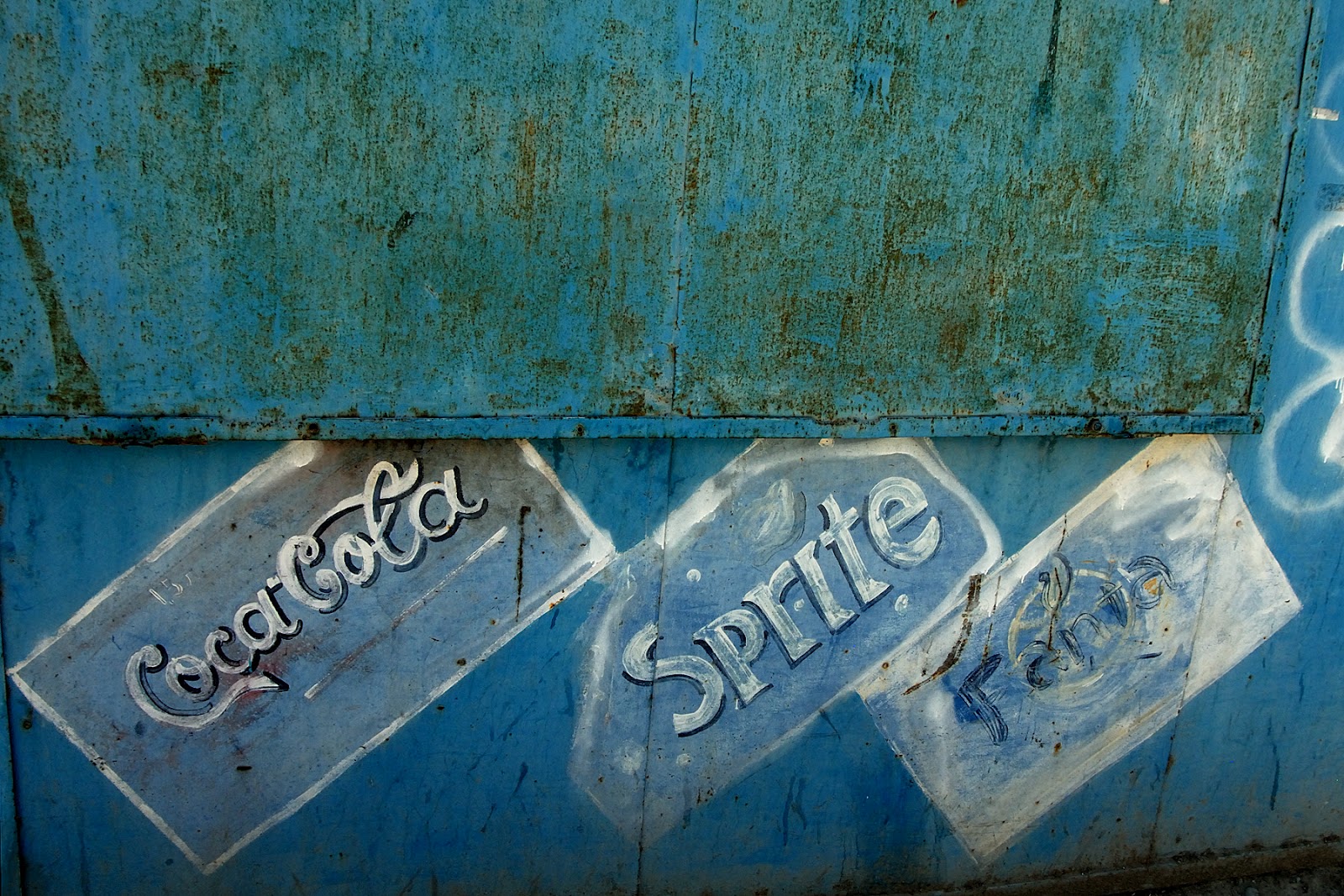
Coca Cola sign near Oaxaca, Mexico.
(Click images to view large)

Soda has been in the news lately, with Bloomberg's move to attempt a ban on enormous drinks sizes in New York City to slow the obesity epidemic.  I have to admit that his effort seems random and unlikely to make any difference, though I appreciate that the problem is getting air time as a result.  The bigger issue is the ubiquitous marketing--especially to kids.  Thankfully, Bei doesn't like "fizzy drinks," so we haven't had to fight that fight in our house, but many of her friends are already into the soda.  I used to drink Coca Cola in my youth, before I discovered the pleasures of coffee, but now I rarely touch the stuff.

An exception though, is the comfort of an ice cold soda during international travel, when water can be more problematic and less available, ironically.  I remember on my first international trip--in the 1980s to climb in the Andes--how nice it was to find orange Fanta for sale from little shacks along trails high in the mountains.  Or how refreshing a truly cold Coke tastes in steamy Bangkok when it's still too early for an ice cold beer.  

Although Coca Cola and it's ilk are found the world over, there are also odd local variants on soda. In Oaxaca, there were advertisements for Manzanita soda (without rival!).  Somewhere overseas (I can't remember where), I tried a local soda, alarmingly yellow, that tasted like bubble gum.  I spit it out, and moved on.  In Peru, soda was often sold by street vendors in plastic bags with a straw.

Perhaps at our core we're all like hummingbirds--irresistibly attracted to sugar water and the bright red signs advertising it.  But unlike hummingbirds, we don't have little wings to flap hundreds of times per minute to burn off the extra calories.  I guess I'll have another cup of coffee. 

Manzanita, without rival.  Oaxaca, Mexico.

Hand made advertisement, Western Kazakhstan.

Sprite, melon market, Urumqi, Xinjiang, China.

Coca Cola at a field day, Kukanga School, rural Uganda.

Coca Cola umbrella, Kampala, Uganda.


Friday, February 10, 2012

Oaxaca -- Religious Iconography

Church room, Mitla, Oaxaca, Mexico.  2007.
(Click images to make bigger)

Perhaps because I'm a skeptical agnostic I'm fascinated by religious iconography, and I find myself photographing it wherever I go.  Mexico is fantastic for this.  Catholicism, with all of its symbols, is strong, and signs of it are everywhere.  In 2007 I spent a week visiting Oaxaca, in southern Mexico.  I just heard on the radio today, that there are travel warnings for Americans in place again for much of Northern Mexico, but that Oaxaca is considered relatively safe from the violence of the drug wars, along with some of the Mexican resort destinations.  If you haven't been to Oaxaca, put it on your list.  The city itself is a thriving center for the arts, with a huge number of high quality galleries, and good restaurants to go with them.  The surrounding countryside is dotted with interesting villages centered around gorgeous old cathedrals, and there are opportunities to hike through spectacular mountainous terrain and deep limestone gorges.  Plus, they make mescal in this part of Mexico.  If you didn't know, tequila is a small subset of mescal, and aficionados can offer mescal tastings that will leave you not caring whether the last one you tried was any good or not.  But getting back to religious icons--I'll post up a few images from the Oaxaca area, and perhaps add images from other countries from time to time since I have so many of them.

Cathedral at Mitla, outside of Oaxaca.

Calendar

Cathedral at Mitla.

Graffiti in the City of Oaxaca.

Crosses, City of Oaxaca.

Window display, City of Oaxaca.