Showing posts with label abandoned. Show all posts

Monday, December 5, 2022

Green River, Utah

Frank's Pizza. Green River, Utah.
(Click on images to view larger)

Last May (2022), Ellen and I rode (I did a lot of pushing) our mountain bikes with five friends for 170 miles down the spine of the San Rafael Swell to Capitol Reef. We convened before the trip in Green River, Utah and camped north of town at Swasey’s Beach, a sandy strand where the river exits Gray Canyon. The wind sandblasted the campground the night before our friends arrived, but we spent time in town before the windstorm buying food at the Melon Vine Food Store, visiting the John Wesley Powell Museum, looking for a good milkshake, and wandering through wide, mostly empty streets in stark sunshine.

Our camp at Swasey's Beach Campground as the sandstorm gathered.

Green River was originally a ferry crossing, but now it is known for it's melons, a minor hub for river runners, and a gas stop for people passing by on I-70. While not necessarily depressed, the town isn't thriving. Many older buildings are closed up and vintage hotels are shuttered and posted with no trespassing signs, having lost their business to chain lodging closer to the freeway. 


After grocery shopping, I enjoyed photographing nearby in the bright sun, usually less appealing to me than gentler light, but somehow fitting in a stark, scrappy, overexposed desert town. The scenes reminded me of photographers whose work I come back to again and again, Stephen Shore and William Eggleston, pioneers of color images, often of mundane sites, captured in ways that infuse them with meaning. Eudora Welty said of Eggleston’s work that “no subject is fuller of implications than the mundane world,” and perhaps there is truth to that. Shore’s images have been described as “bleak but lyrical” and his style as laconic even though it has a lot to say. Sally Mann, another photographer, says in her excellent memoir "Hold Still", "It is easier for me to take ten good pictures in an airplane bathroom than in the gardens at Versailles."


Photographs draw attention to places that might otherwise be overlooked . 

Book Cliff Lodge. Green River, Utah.

World Peace.

Beer.

Hotel.

Cut and Curl.

Bar.

Green River and the San Rafael Swell.


Tuesday, November 15, 2022

What Rhymes with Route 20?


School west of Lusk at dusk.
(Click images to view larger)

You can get your kicks on Route 66, and Route 50 traverses enough desert in Nevada to be called “The Loneliest Road in America,” but other major U.S. highways either don’t rhyme well or are more social. In the U.S., coast-to-coast highway numbers end in “0”, increasing from north to south, but there are exceptions. U.S. 10 originally extended only from Detroit to Seattle, but it was considered important enough to earn its number. Many older routes have been subsumed by interstate highways, but you can still follow long stretches where small towns and remnants of 1950s motor culture mingle with newer development. 


I spent a weekend photographing in Western Nebraska last January (2022) (see blog post), and a good deal of time last summer driving back and forth to the East Coast (blog post), avoiding freeways when I had enough time. Those trips piqued my interest, so Ed Sherline and I (see his excellent photography and Wind River rephotography project) headed to Western Nebraska for a weekend in early November. We made our way east along Hwy 20 from near Glendo, Wyoming into the Nebraska sandhills to Valentine before turning south and then east towards home on Hwy. 26, itself a major route extending from Nebraska to Oregon. 


Ed and I get out once or twice a year to shoot photos. It’s an opportunity to commiserate about politics, talk about trips we’ve done and trips we’d like to do, nerd-out about photography without boring our families, eat unhealthy food, and drink unhealthy drink. Even though we stop at the same places, we always come home with different images. The photographer David DuChemin made the point in a recent blog post that even though “it’s all been done,” each of us brings a unique point of view to our photographs, something to strive for.


Shawnee, Wyoming cafe, Hwy. 20.

Abandoned trailer west of Lusk, Wyoming.

Lost Bar, Lost Springs, Wyoming.

Playground, Lost Springs, Wyoming.

Garage, Harrison, Nebraska.

Abandoned house east of Harrison, Nebraska, beside Hwy. 20.

Sunflower along Hwy. 20, Western Nebraska.

Garage, Hwy. 20, Western Nebraska.

Truck detail, Hwy. 20, Western Nebraska.

Steering wheel, Hwy. 20, Western Nebraska.

Grain elevator, Hwy. 20, Nebraska.

Abandoned motel, Hwy. 26, Western Nebraska.

Old downtown, Henry, Nebraska.


Friday, September 2, 2022

Hollowed Out

Empty marquis. Granville, IL.

I drove twice this summer (2022) from Laramie to Tidewater Virginia where my parents retired over twenty years ago. My father died in 2019, but my mother clung to their home on the Chesapeake Bay as long as she could before reluctantly moving to Austin, Texas in July, closer to family but far from her Gloucester friends. 

I grew up in Northern Virginia, but after my first glimpses of the West, I was eager to leave. A family road trip in the mid-1970s took us through Wyoming, sealing my fate, and I moved to the Tetons soon after college. My father's parents loved the Tetons, visiting in the 1940s and spending time on Jenny Lake. Eisenhower's interstate highway project didn't begin until the 1950s, and for Easterners, trips "out West" were slower; small towns with their "classic" diners and gas stations interrupted two-lane highways devoid of fast food. 

After World War II, the Midwest thrived for a time (see Flora and Flora 2014) even as the seeds of its decline took root. Towns bypassed by the new interstate highways eventually faltered, corporate agriculture subsumed family farms, and opportunity lured young people to cities. 

I deliberately stayed off the interstates on my first drive east this summer, hoping to photograph small towns along the way ala Stephen Shore, but I was plagued from Colorado to Virginia by relentless rain. St. Louis was inundated soon after I passed through, and later in the summer thousand-year floods devastated Eastern Kentucky. I stopped to photograph when the rain slowed, but the trip left me wishing I had more time and better weather. 

I've heard the rural Midwest described as "hollowed out" but despite boarded-up storefronts and empty streets, stone and brick architecture transcends the crass and impermanent suburbs and strip malls that have replaced them. The country is divided and much grievance festers in this "flyover country," festooned with Trump banners and American flags, maybe because people struggle to find someone or something to blame for so much loss. 

Abandoned house. County Road 119, Colorado.

Abandoned building, highway 14, New Raymer, CO.

Window displays, New Raymer, CO.

John Deere and grain elevators, New Raymer, CO.

Interior, northwest Kansas.

Interior, northwest Kansas.

Easy chair, northwest Kansas.

Broom, northwest Kansas.

Kansas plains.

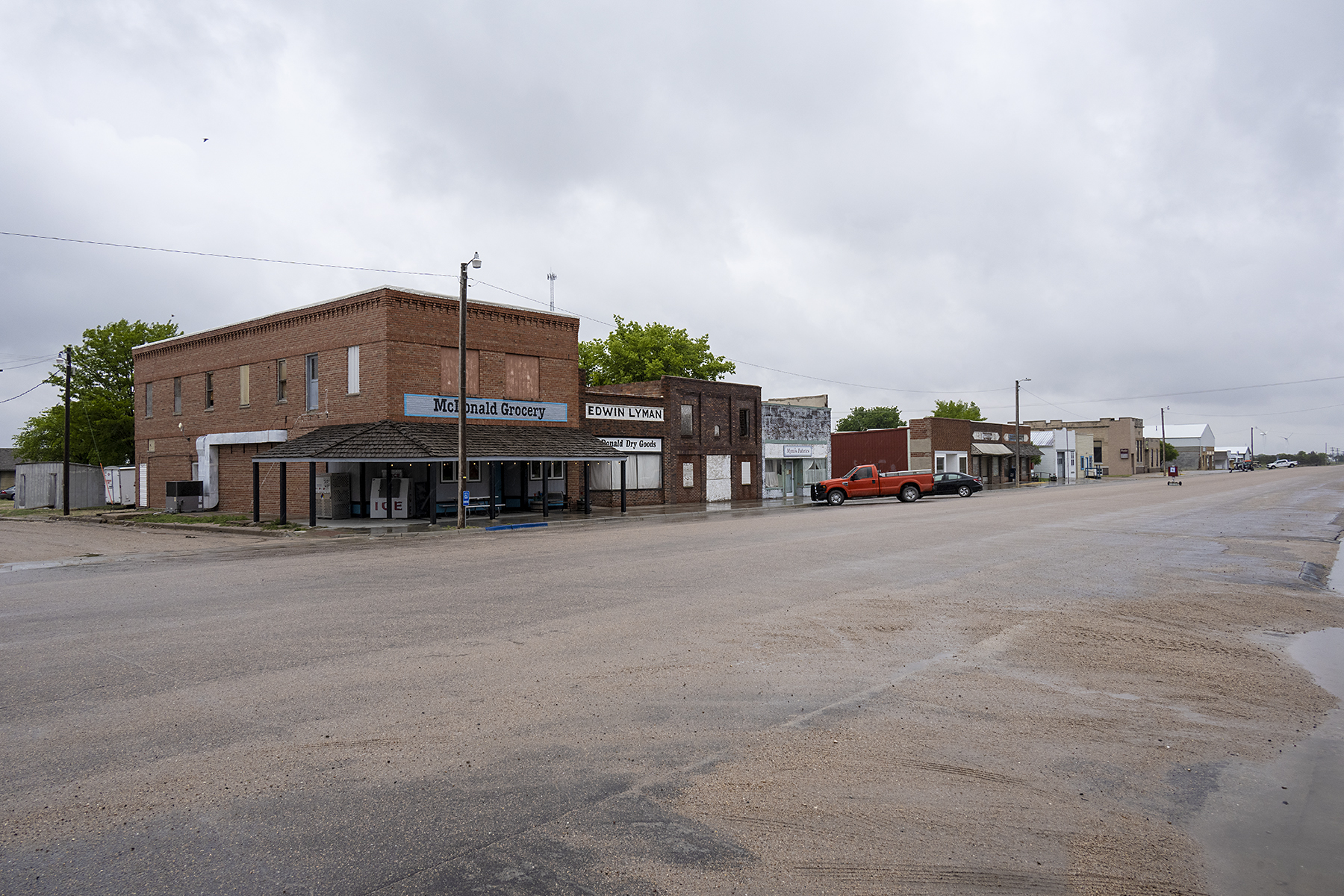
MacDonald, Kansas.

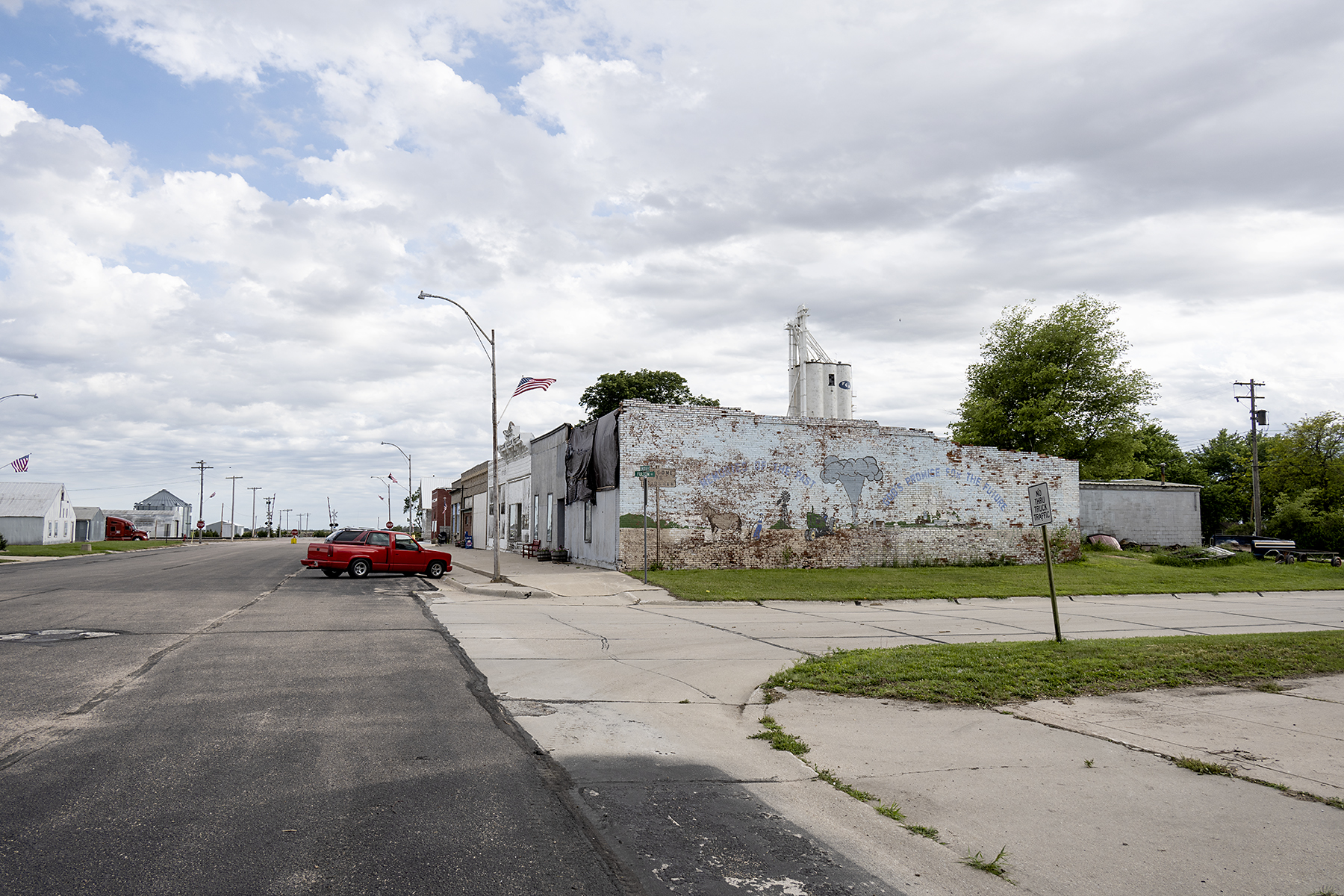
"God's Promise for the Future" (mural), Bradshaw, Nebraska.

Tilted building, Norcator, Kansas.

Abandoned farmhouse, Rt. 24 west of Clay Center, Kansas.

Troughs west of Clay Center, Kansas.

Farm interior west of Clay Center, Kansas.

Drilling equipment, Carmi, Illinois.

Empty church, Hwy. 168, Indiana.

Church interior, Hwy. 168, Indiana.

Fire hydrant, Hwy. 168, Indiana.

Cook's Marine, Georgetown, Indiana.

Dehart's Bible and Tire. Morehead, Kentucky.

Hinton Hardwoods, Hinton West Virginia.

Hinton, West Virginia.

Manequins, Rts. 3 and 12, West Virginia.

Vegetation, Blue Ridge Mountains.

Forks of Buffalo, Virginia.