Sunday, July 7, 2013

Ireland: Beara Peninsula


Stone shed and fox glove, just up the road from our cottage.
(Click images to view larger)

We’ve been in Ireland for nearly 10 days, mostly staying at a cottage on the Beara Peninsula (SW Ireland, Cork County) with no internet.  Arrived in London late last night.  I’ll try to catch up on blog posts over the next week or so.  It’s harder than I thought when we are so busy traveling.

Where to start?  We built a fire on a wet night—with blocks of  compressed peat.  A sheep grazes every evening in our backyard—an orphan raised by the people who own our cottage, and it stays close even in adulthood.   Dogs are friendly. 

Megalithic graves dot the hillside a short walk up the road—elongated rings of stone, thousands of years old, sinking into the turf.  Old stone walls form exquisite flower gardens.  There’s heather…and gorse.

I drive in the passenger seat down narrow roads, shifting gears with my left hand and diving into tiny pull-outs to avoid oncoming locals, who don’t need to slow down they are so practiced.

The man at the nearby store tells us that the local cheese stinks, and that he “wouldn’t touch it.”  Black pudding (made with pigs blood) is part of the “Irish breakfast,” but none of us quite have the nerve to try it. 

My most embarrassing Ireland vacation fact:  I never made it to a pub.  We’re tired at night, the girls don’t want to go, and our cottage is a nice place to sit and have a cold one while the sun sets.  Plus, I don’t really like Guinness.   On another trip!  

All of this in a place that is fantastically beautiful.  Here are a few pictures... 

Gate and sheep pasture, just up the hill from our cottage.

A cairn on a hill above the cottage--megalithic tombs dot the hillside between here and the sea (Atlantic Ocean).

Flowers on a stone wall.

Fishing boat.

Fox glove and wild fuscia.

Stone shed near our cottage.

The girls above Allihies, an old copper mining town.  Many of the miners left for Butte, Montana when the jobs ran out.

The walking road to Allihies (Ellen and I walked here one morning while the girls slept!).

On the coast.

One of many old graveyards on the peninsula--lots of O'Sullivans and Harringtons.

The girls above the sea.

Ellen on the summit of Knocknogalaum (spelling may be off!).  Our most alpine experience in Ireland.

Castletownbere.

Sunrise, Beara Peninsula

Ancient stone circles.

Sunday, June 16, 2013

Canyoneering: Zion National Park

Mike Kehoe downclimbing in Spry Canyon, Zion National Park.
(Click images to view larger)

In some ways, Zion National Park is to canyoneering as Yosemite National Park is to climbing--the canyons' reputations precede them (Heaps!), gear is named after them (Imlay!), and canyoneers come from all over the world to sample them.  Cut into the Navajo Sandstone, with most ultimately draining into the Virgin River, the canyons are exceptionally beautiful, often wet, and frequently precipitous, dropping hundreds or more feet from plateau to river.  They can also be surprisingly cold, and canyoneers don full wetsuits or drysuits despite summertime temperatures of 100+ degrees.  Like green oases in the desert, the canyons support huge Douglas fir and Ponderosa pine trees, ferns, wildflowers, and communities of frogs than can hop up vertical rock.  It's a spectacular place.

A week ago six of us (myself, Jim Akers, Don Reyes, Steve Millard, Mike Kehoe, and Tom Bonnet) converged on Zion and spent six days enjoying six canyon outings, culminating in an 11.5-hour descent of the Imlay Sneak Route in low water condition (lots of pothole escapes).  

A selection of photos follow with links to Tom Jones' detailed canyon descriptions.  

[Tomorrow I leave for six weeks of travel--first to the East Coast for a few days, and then to Ireland, England, France, Switzerland, and Italy for five weeks.  I hope to post regularly while we're traveling.]

Cars are banned (mostly) in the main canyon, and shuttle buses provide convenient transport to and from adventures.  On our way to Echo Canyon.


Jim Akers, Echo Canyon.


Tom and Steve, cooling off after descending Pine Creek Canyon.  

Local resident in Pine Creek.

"The Death Gully," Mystery Canyon.

Rappel, Mystery Canyon.

Mike Kehoe, Mystery Canyon.

Tom Bonnet, Mystery Canyon.

Mike Kehoe and Steve Millard, setting up rappel from Mystery into the Virgin River narrows where an audience awaits our descent.

Mike Kehoe, Das Boot.

Steve Millard, Spry Canyon.

Don Reyes, Spry Canyon.


Steve Millard, preparing to hook out of a keeper hole in Imlay Canyon.

Mike Kehoe, hooking in Imlay.

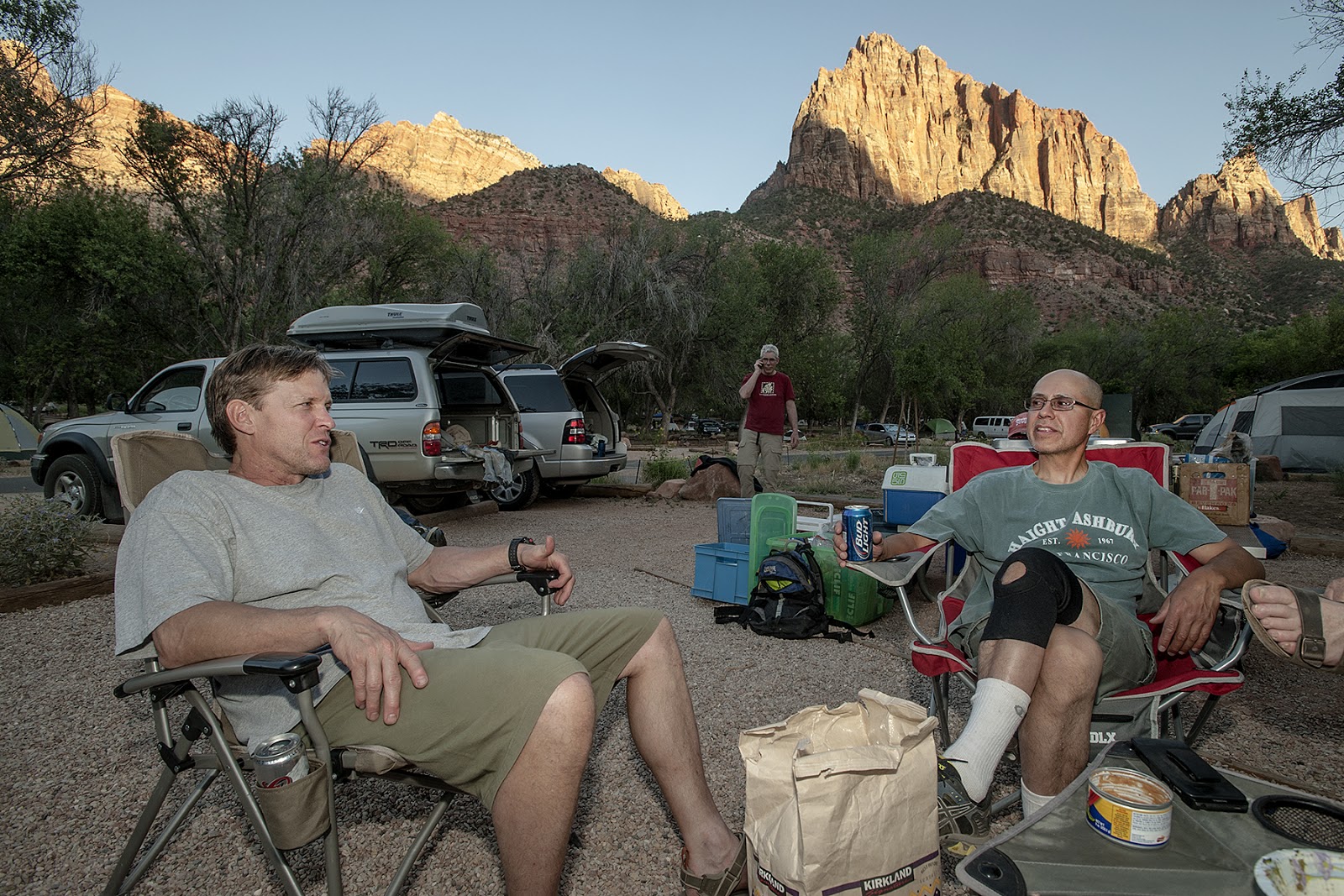
Post-canyoneering refreshment, Watchman Campground.


Thursday, June 6, 2013

Red Desert: Signs of Humans

Stock trough, Honeycomb Buttes, Red Desert.
(Click images to view larger)

I spent last weekend in the Red Desert with fellow photographer Ed Sherline.  We started in Rawlins where we met up with Christi Chapman, whose family ranched in the area when she was a kid.  Christi led us out to  a strange and obscure relic of human occupation--a large "mansion" build sometime in the last 50 years and then abandoned to weather, cows, vandals, and great horned owls.  From there we continued to the also abandoned but less mysterious Jawbone Ranch, named, according to Martin Stupich'es book on the Red Desert, because it was "financed on talk."  

Ed and I continued alone to the Honeycomb Buttes in the northern part of the Red Desert, a spectacular badland area, where we spent the remainder of the weekend until we emerged on South Pass and descended through spectacular wildflowers at the head of Red Canyon before heading for home.  

I'm leaving town today for the start of almost two months of travel, so I don't have time to say much more, but I want to post a few images before hitting the road.  I have many more, mostly of the natural appeal of the Honeycombs, but will focus here on random signs of humans in the desert, some easily explained and others weird as all get out.  

As I travel, I'll try to at least post photographs from time to time. 

The Red Desert "mansion," accessed only by obscure two-track roads.  

Sink in the mansion.

Murphy bed and peeling paint, Jawbone Ranch, Red Desert.

Jawbone Ranch.

Slow motion collapse, Jawbone Ranch.

Rusting culvert, Chain Lakes, Red Desert.

55-gallon drum (empty).  Honeycomb Buttes, Red Desert.

Railroad tie fence posts.  Honeycomb Buttes, Red Desert.

6-ounce Coca Cola bottle.  Red Desert.


Saturday, May 11, 2013

A brief update on our cats

Henry.  July 2012.
(Click images to view larger)

As they are wont to do, our kittens, Henry and Pysmon, now approaching 1-year-old, have grown, and though they now look like cats, they still act like kittens. They're a little lazier than they were, but they can knock over larger objects than they once could. 

I'm exposing myself to all sorts of criticism by blogging about our cats, I know. There's a lot of over sharing about cats on the web--from viral YouTube videos to endless slide shows with tacky transitions. But they're a pretty big part of my day--they wake me up in the morning and greet me when I come home from work.  

OK.  I'll stop.

August, 2012.

Psymon.  August 2012

October 2012

Henry (jumping).  November 2012

December 2012

With Brava and Smudge, December 2012.

February 2013

March 2013

May 2013