Sunday, June 16, 2013

Canyoneering: Zion National Park

Mike Kehoe downclimbing in Spry Canyon, Zion National Park.
(Click images to view larger)

In some ways, Zion National Park is to canyoneering as Yosemite National Park is to climbing--the canyons' reputations precede them (Heaps!), gear is named after them (Imlay!), and canyoneers come from all over the world to sample them.  Cut into the Navajo Sandstone, with most ultimately draining into the Virgin River, the canyons are exceptionally beautiful, often wet, and frequently precipitous, dropping hundreds or more feet from plateau to river.  They can also be surprisingly cold, and canyoneers don full wetsuits or drysuits despite summertime temperatures of 100+ degrees.  Like green oases in the desert, the canyons support huge Douglas fir and Ponderosa pine trees, ferns, wildflowers, and communities of frogs than can hop up vertical rock.  It's a spectacular place.

A week ago six of us (myself, Jim Akers, Don Reyes, Steve Millard, Mike Kehoe, and Tom Bonnet) converged on Zion and spent six days enjoying six canyon outings, culminating in an 11.5-hour descent of the Imlay Sneak Route in low water condition (lots of pothole escapes).  

A selection of photos follow with links to Tom Jones' detailed canyon descriptions.  

[Tomorrow I leave for six weeks of travel--first to the East Coast for a few days, and then to Ireland, England, France, Switzerland, and Italy for five weeks.  I hope to post regularly while we're traveling.]

Cars are banned (mostly) in the main canyon, and shuttle buses provide convenient transport to and from adventures.  On our way to Echo Canyon.


Jim Akers, Echo Canyon.


Tom and Steve, cooling off after descending Pine Creek Canyon.  

Local resident in Pine Creek.

"The Death Gully," Mystery Canyon.

Rappel, Mystery Canyon.

Mike Kehoe, Mystery Canyon.

Tom Bonnet, Mystery Canyon.

Mike Kehoe and Steve Millard, setting up rappel from Mystery into the Virgin River narrows where an audience awaits our descent.

Mike Kehoe, Das Boot.

Steve Millard, Spry Canyon.

Don Reyes, Spry Canyon.


Steve Millard, preparing to hook out of a keeper hole in Imlay Canyon.

Mike Kehoe, hooking in Imlay.
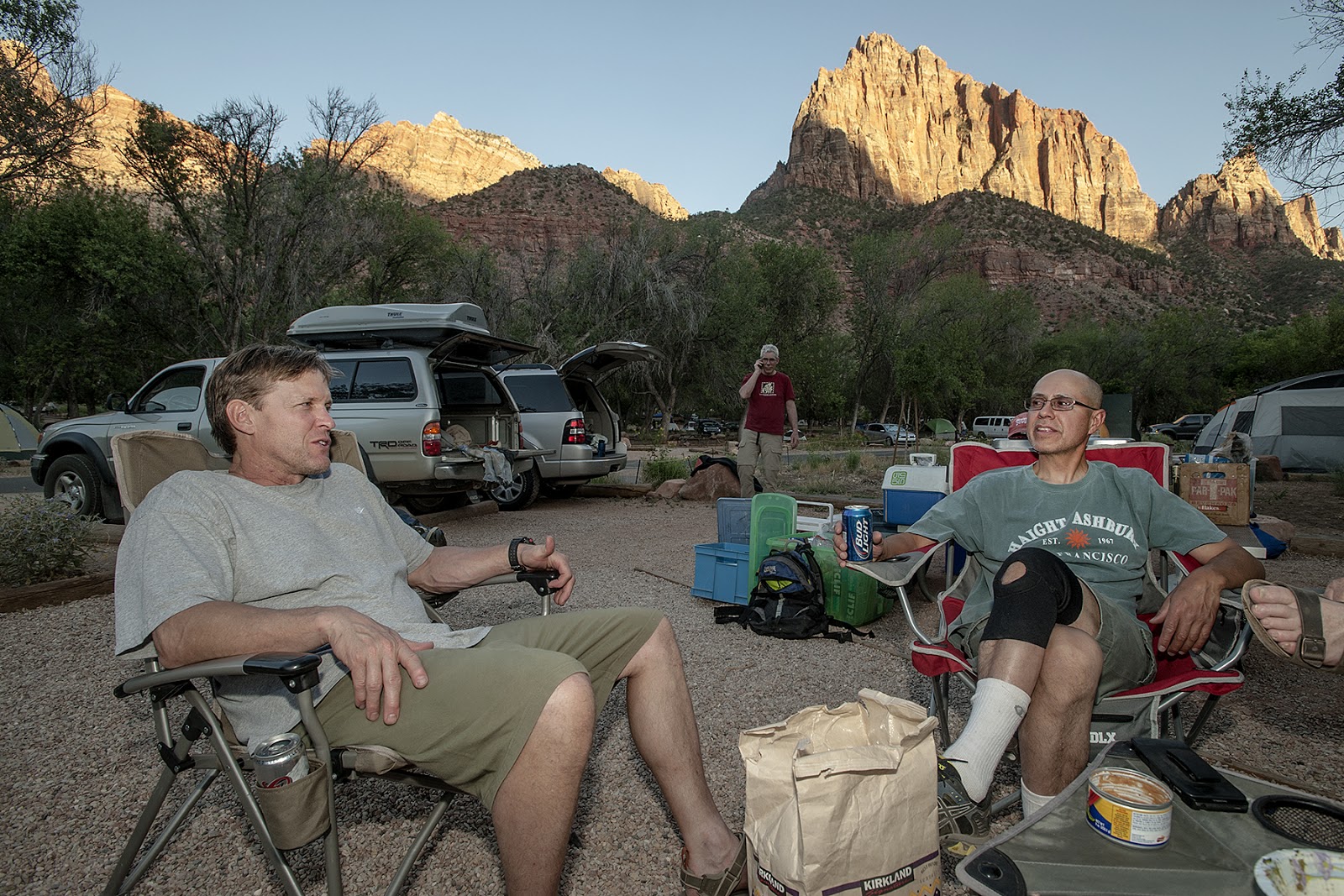
Post-canyoneering refreshment, Watchman Campground.


Thursday, June 6, 2013

Red Desert: Signs of Humans

Stock trough, Honeycomb Buttes, Red Desert.
(Click images to view larger)

I spent last weekend in the Red Desert with fellow photographer Ed Sherline.  We started in Rawlins where we met up with Christi Chapman, whose family ranched in the area when she was a kid.  Christi led us out to  a strange and obscure relic of human occupation--a large "mansion" build sometime in the last 50 years and then abandoned to weather, cows, vandals, and great horned owls.  From there we continued to the also abandoned but less mysterious Jawbone Ranch, named, according to Martin Stupich'es book on the Red Desert, because it was "financed on talk."  

Ed and I continued alone to the Honeycomb Buttes in the northern part of the Red Desert, a spectacular badland area, where we spent the remainder of the weekend until we emerged on South Pass and descended through spectacular wildflowers at the head of Red Canyon before heading for home.  

I'm leaving town today for the start of almost two months of travel, so I don't have time to say much more, but I want to post a few images before hitting the road.  I have many more, mostly of the natural appeal of the Honeycombs, but will focus here on random signs of humans in the desert, some easily explained and others weird as all get out.  

As I travel, I'll try to at least post photographs from time to time. 

The Red Desert "mansion," accessed only by obscure two-track roads.  

Sink in the mansion.

Murphy bed and peeling paint, Jawbone Ranch, Red Desert.

Jawbone Ranch.

Slow motion collapse, Jawbone Ranch.

Rusting culvert, Chain Lakes, Red Desert.

55-gallon drum (empty).  Honeycomb Buttes, Red Desert.

Railroad tie fence posts.  Honeycomb Buttes, Red Desert.

6-ounce Coca Cola bottle.  Red Desert.


Saturday, May 11, 2013

A brief update on our cats

Henry.  July 2012.
(Click images to view larger)

As they are wont to do, our kittens, Henry and Pysmon, now approaching 1-year-old, have grown, and though they now look like cats, they still act like kittens. They're a little lazier than they were, but they can knock over larger objects than they once could. 

I'm exposing myself to all sorts of criticism by blogging about our cats, I know. There's a lot of over sharing about cats on the web--from viral YouTube videos to endless slide shows with tacky transitions. But they're a pretty big part of my day--they wake me up in the morning and greet me when I come home from work.  

OK.  I'll stop.

August, 2012.

Psymon.  August 2012

October 2012

Henry (jumping).  November 2012

December 2012

With Brava and Smudge, December 2012.

February 2013

March 2013

May 2013


Sunday, April 28, 2013

Canyoneering: Big Spring East and West Forks

Don Reyes advertises for Canyoneering USA, while threading the West Fork of Big Spring Canyon
(Click images to view larger)

I just returned from the first of two canyoneering trips scheduled this season--this one to the High Roost of Utah.  We'll visit Zion for a week in June.  

Each canyoneering trip is different.  This one distinguished itself in two ways:  1) there were so many of us that we had to split into two groups after the first day, and 2) we rappelled from sand.  I'm not sure that twelve people is an ideal number for canyoneering, but it was a great group that grew from our small core  to friends and friends-of-friends.  More on that in another post, but it was great to meet some new people and to reunite with some old friends, even if we did have to split up to keep our descents manageable.  

The sand rappelling, surprisingly, is not as bad as it sounds, especially when it's an alternative to no anchor or to using a single small hook in a shallow hole in soft sandstone.  The ethic in many canyon descents is to pass with as little impact as possible ("ghosting"), so bolt anchors are rare.  The principle of a sandtrap is simple:  you pile a bunch of sand on a specially-constructed tarp that has webbing sewn into it for tying off rope.  The rappel rope is attached to the front of the tarp and a pull cord to the rear.  Everyone except the last person is backed up by a human clipped to the tarp while they rappel.  Then, after the last rappeller survives, a hearty pull on the rear rope dumps the sand off the tarp and retrieves it.  There's a photo below if you can't quite picture what I'm talking about.  We ended up using this technique several times on this trip and I'm convinced that I need to spend $100 to buy myself a sandtrap.    

The High Roost, if you haven't heard of it, is west of the Green River, about 60 miles of dirt road , some of it tediously rough,  from Utah Highway 24.  It occupies a large area east of Horseshoe Canyon, an isolated unit of Canyonlands National Park famous for big pictograph panels.  There are a handful of excellent canyons here that distinguish themselves by being especially beautiful and by requiring rappels from transitory anchors.  

Our first outing was through two forks of Big Spring Canyon--we descended the West Fork and ascended the East, the latter to avoid two trips up the ridge between the forks, which are typically both descended. Note to self:  ascending slot canyons is more strenuous than hiking ridges between them twice.  

These photos (many) are from our day in Big Spring... 

Steve Millard, studying the approach.

Dropping into the West Fork.

Collaborative human anchoring--a group effort.

Larry Scritchfield serving as a rappel anchor, and loving it.

A rare (single) bolt anchor.

Jim Akers on rappel from a single bolt anchor.  

Descending the West Fork.

Ken Sheldon in the West Fork.

Building a sand trap anchor.

The sandtrap.  

Into the darkness.

Descending.

West Fork sandstone.

Larry Scritchfield, Don Reyes, Bret Ruckman, Steve Millard:  West Fork.

Bret Ruckman.

Jim Olson (Jaime) at the "triple bridge" in West Big Spring.

Steve Millard, ejecting from the Triple Bridge.

The end of the descent of the West Fork.

Jim Olson, Jim Akers, and Bret Ruckman contemplating an obstacle during our ascent of the East Fork.

Bret, climbing through an arch in the East Fork.

A trapped bird (fledgling) in the East Fork.  We couldn't really help it escape, but hope that it did.  

Jim Akers, Steve Millard, and Bret Ruckman at the top of the East Fork, ready for chips, salsa, and margaritas.