Tuesday, January 7, 2014

Lucca, Italy

The busy streets of Lucca in summer.  Shopping is rampant.
(Click images to view larger)

Last summer (2013), after our battles with the crowds and heat at Cinque Terre, we high-tailed it to Lucca, Italy, which we'd been told was a fun place to stay with easy access to the famous Leaning Tower of Pisa, a sight the girls wanted to see despite the Tuscan heat and previous experiences with tourist hot-spots.  

What a relief Lucca turned out to be.  We stayed in a perfect apartment (Airbnb) and enjoyed a couple of nice days exploring the narrow streets of this cosmopolitan town, just missing the summer festival with concerts by the likes of Leonard Cohen, Neil Young, and Earth, Wind and Fire.  We stumbled onto a surprise exhibition of photographs by Henri Cartier-Bresson, famous for capturing "the decisive moment" with his Leica rangefinder, and we ate lots of gelatto, climbed old towers for the views, hiked around the city walls, and relaxed a bit before our dash to Milan for our flight back to New York. 

A tiny amount of history seems called for.  Lucca was founded by the Etruscans and became a Roman colony in about 180 B.C (see Wikipedia).  Julius Caesar ("Who the hell is Julius Caesar?  You know I don't follow the NBA!" --Will Ferrell from the recent Anchorman sequel) spent time here.  The composer Puccini was born in Lucca and played his organ here during his childhood. Because Lucca survived WWII unbombed, many features of the Medieval town are preserved, most famously the town walls, which are now pedestrian promenades.  And of course, Neil Young played his mouth organ here in 2013, but we missed it, though I'm not bitter about that.

Enough of that...here are a few photos from Lucca, a town I recommend if you need to stage yourself near Pisa and if you enjoy Parmesan, vinegar from Modena, and shade.       

Bei, Lauren, and Leigh passing through the town wall into Lucca.

Typical store in Lucca selling "tipico" stuff.

Statues on one of the cathedrals in town.

Ellen denying herself a gelatto.

Photos by Henri Cartier-Bresson.

Photo of William Faulkner by Cartier-Bresson.  To me, Faulkner looks a lot like my grandfather (see below).

My Dad (left), with my grandfather (Ken), and grandmother (Nelle).  We have other family photos in which my grandfather Ken looks even more like Faulkner, but this is the only one I have on my hard drive.

Lucca mailboxes.

Street scene with bicycle.

Cars aren't allowed on many of the streets, so bikes are preferred, though tricky in the summer crowds. 

Cyclist with wine.
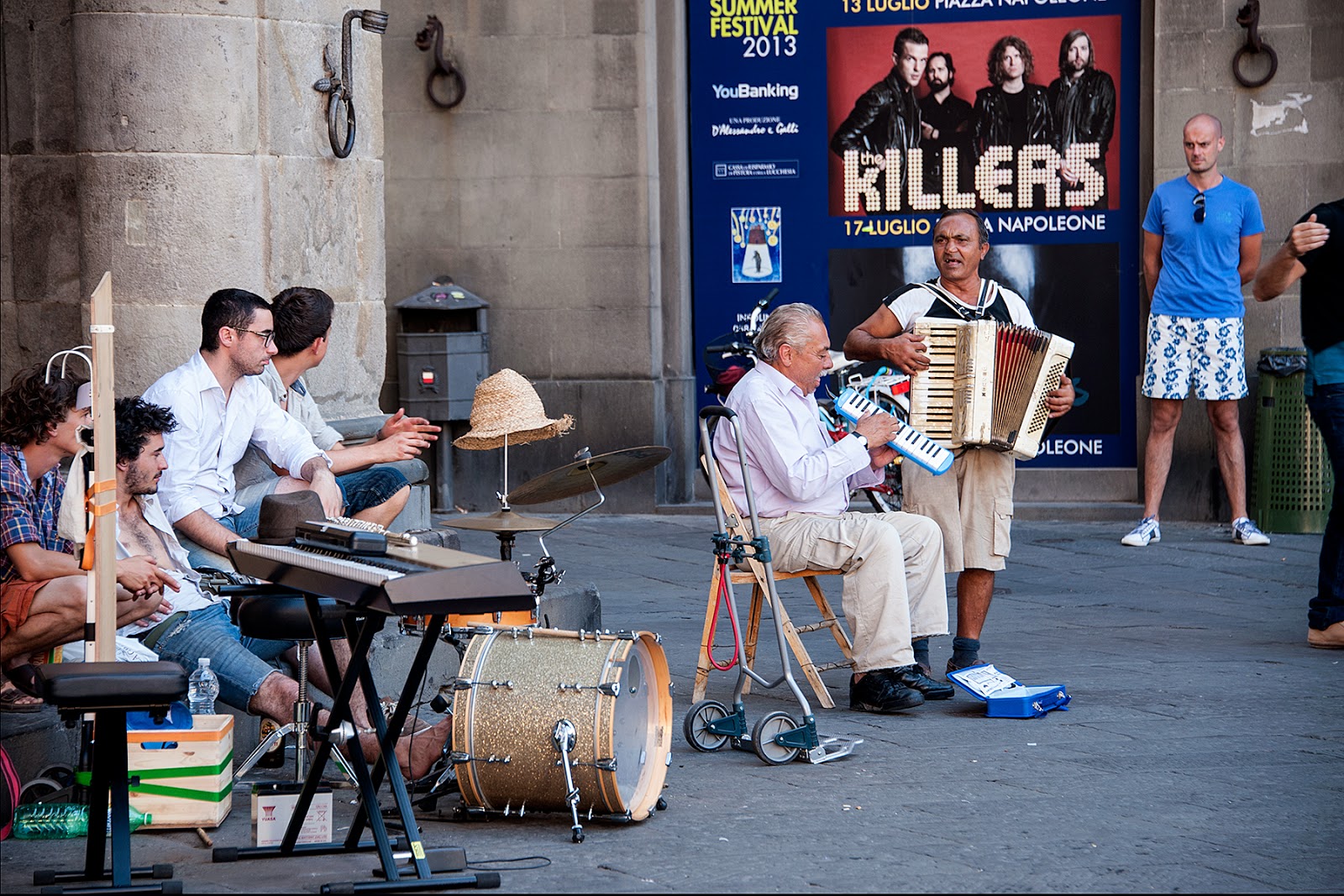
Not Neil Young (or the Killers).


A Lucca summer wedding.  Onlookers point, chant, and dance as the couple emerges.

The girls, dressed to kill and heading out on the town just before ditching their embarrassing grown-up nemeses (me and Ellen).

For you climbers, an anti-stemming device.

A Euro-cat trying to get into one of those Euro-cat calendars, but feeling a little down because he wasn't born in Santorini.

Cathedral sculpture.

Architectural history in brick.

Tuscan weather.

Lucca from one of the many towers in town, none of which are leaning.

A Lucca tower.

The cafe scene at night.

Ellen exploring, just before bedtime.


Friday, December 27, 2013

Cinque Terre: No Parking

Picturesque Manarola, Italy.
(Click images to view larger)

I'm enjoying the holiday and trying to catch up on processing images from the last year, including many from our trip to Europe.  And I'm looking forward to blogging more regularly.  The fall semester overwhelmed me.  I'll start here with a brief description of Cinque Terre on the Italian Riviera.  We visited this at the very end of our summer trip.  I'll post about other European adventures as I get images organized.

The very tiny downside to an academic appointment is that one can travel only in the "high season." In the Northern Hemisphere, this means summer temperatures and summer crowds, and in Europe, where the vacation mentality is saner than in the U.S., it means that every location even hinting at fame becomes overrun with European tourists mixing with those of us from overseas. 

Perhaps I should have known that a place that popped up during a web search for interesting things to see in Northern Italy would not be a great high season choice.  But the pictures of Cinque Terre were so compelling(!):  five lovely little towns pasted to a steep rocky section of the Mediterranean Coast and connected by a hiking trail that could be traversed in a day. What a perfect place to finish a lovely trip!

Cinque Terre has a long history, with towns dating back to at least the 11th century, but for most of this time, the area was isolated by the terrain and a difficult place to live.  While fishing may be a viable way of life, farming doesn't seem to make much sense, and yet the locals over time hacked an elaborate system of terraces into the slopes and planted olive trees and vegetables.  Eventually, a railroad was built along the coast, connecting the five villages to the larger city of La Spezia to the south and providing tourist access, which has transformed Cinque Terre since the 1970s from a backwater to a bustling collection of hotels, restaurants, and shops.  Remarkably though, the original charm of the villages largely remains, at least visually. 

We spent 3 days at Cinque Terre before moving to Lucca, a little farther south, our last stop before flying home from Milan at the end of our month in Europe. Though Cinque Terre is beautiful, I'd avoid it during the high season.  We drove our rental car to a small village high above the coast (Volastra), the only place where I could find a place to stay on late notice.  Avoid that if you go.  Instead, make a reservation in one of the seaside towns (Riomaggiori, Manarola, Vernazza, or Corniglia are best--book early), park in La Spezia, and take the train to your destination.  Check on the status of the hiking trail, damaged by a 2011 landslide and not completely open while we were there, dashing our hopes for a nice hike. And avoid mid-summer crowds and heat if possible.  I was told that the scene in the fall is completely different.  Still, I'm glad to have seen Cinque Terre.  

A few images...

The town of Vernazza.

The harbor at Manarola.  The cool water was a lifesaver if you avoided the jellyfish.

Rock diving at Manarola.

Bei (L) with her cousins Lauren and Leigh, gazing at the Mediterranean.

Manarola.

Boats at Manarola.

Bei was in her element, which is the element where you eat pasta for every meal.  

The coastline is probably too rocky and steep for traditional cemeteries.

Fishing in the Med.

Railway at the edge of the sea.

Castiglioni.

Ellen hiking into Vernazza, after sweating it out on the trail through the olive groves between here and Corniglia.

Decoration in the Volastra cathedral.

A disgruntled cat in Volastra, perhaps unhappy about the tourists?

No parking.  
The five towns were nearly impossible to access with a car, because parking is so limited.  Take the train!


Wednesday, December 25, 2013

Merry Christmas

Christmas in China -- 2005.

Merry Christmas!  Here's looking forward to 2014 and a more active blog.  I hope you have a fantastic holiday.  

Christmas in Laramie -- 2013.


Tuesday, November 5, 2013

Art opening tonight at the UW Math and Science Teaching Center

Badlands at Robber's Gulch, in the Red Desert north of Baggs, Wyoming.

I'm participating in an art show that opens tonight (November 5) at the Math and Science Teaching Center on the University of Wyoming campus.  The opening is from 6:30-8:30, so if you're in town, stop by and have a look.  There will be lots of art there from local artists. The show is on the 4th floor of Wyoming Hall.

Honeycomb Buttes, Red Desert, Wyoming.

Dawn, Pine Bluffs, Wyoming.


Saturday, October 26, 2013

Canyoneering: Not Sandthrax

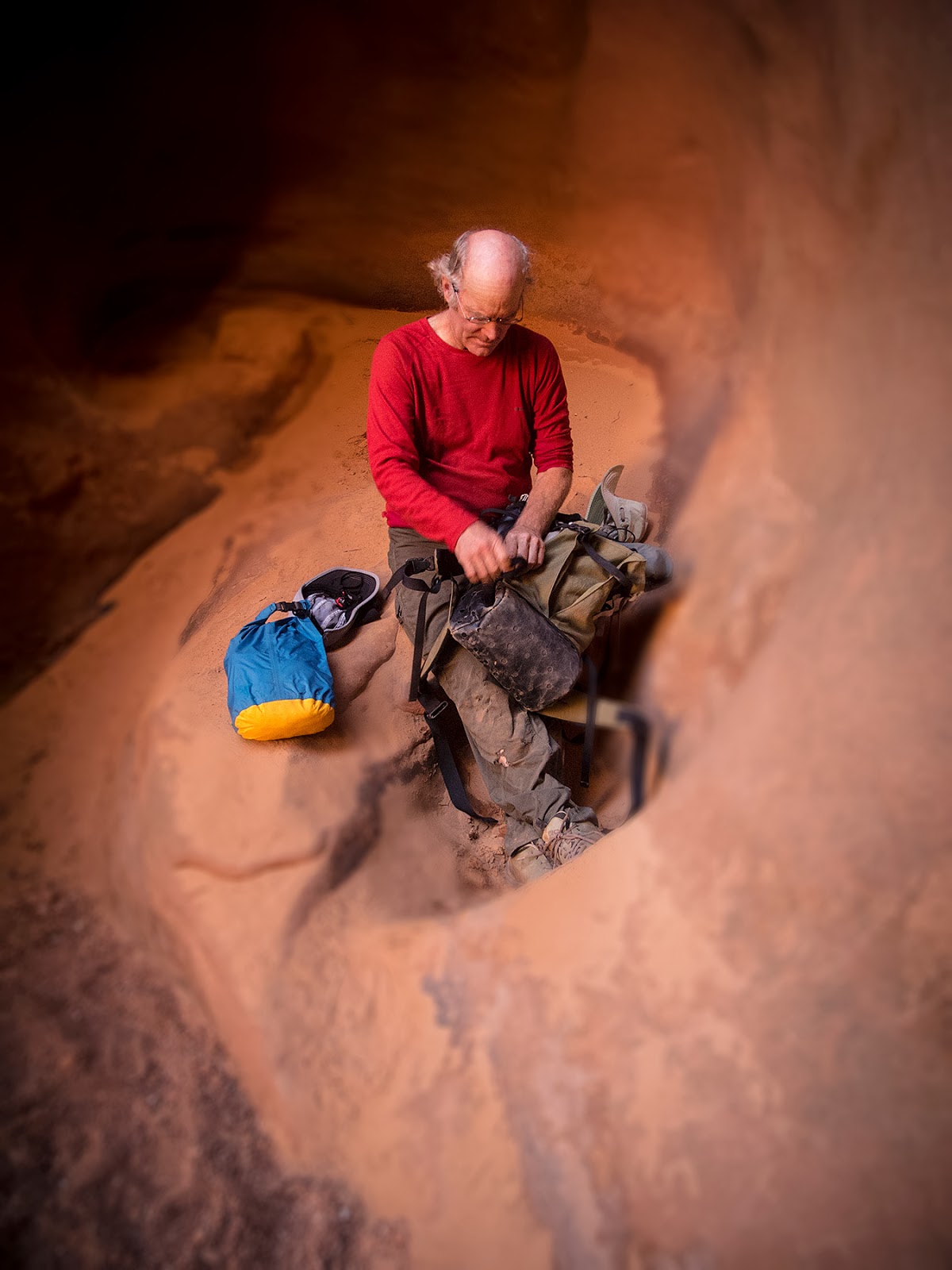
Jim Akers not in Sandthrax (East Leprechaun Canyon, North Wash)
(Click images to view larger)

If you’re afraid, don’t do it.  If you do it, don’t be afraid.” – Mongolian Proverb

The canyon that  threatened us the most on our recent fall canyoneering trip is called Sandthrax, and there had been a lot of e-mail chatter before the trip about going for it despite its reputation.  Don Reyes, from Tahoe, was the keenest, while the rest of us (Ken, Larry) were more jittery but maybe willing.  I'd vacillated before the trip, but decided I’d go in if everyone else was game.  We had experience, gear, and a rim crew (Jane, Jim) that could potentially save us if we got trapped. 

The internet is rich with dramatic stories about Sandthrax, with titles like “The Chasm of Doom.”  Climb-Utah.com warns that “Errors in technique or judgment will likely result in serious injury or death.”  The canyon has an X rating, meaning that a screw-up can lead to, well:  death.  But other descriptions didn't sound that bad—moderate stemming high off the ground--mostly secure with a few tricky places and one distinct crux that could be at least partly aided with fat cams.

Tom Jones, founder of Canyoneering USA, and another canyon guide who happened to be in the North Wash while we were there had told us that the recent rain made the rock friable, and that it was best to stay out of Sandthrax for 4-6 days until it dried, giving us another piece of information to chew on.  But as the weekend progressed under crisp, dry fall skies, the rains seemed less relevant.

Around the campfire we circled the idea, our numbers diminished by the last-minute absence of Steve Millard, who was recovering from a bad hip, and Mike Kehoe, who had cancelled because of unexpected business travel.  This was relevant, because there is safety in numbers in technical canyons;  three or four people are ideal for Sandthrax.

Maybe we have the technique and judgment went the campfire discussion (Don), as we sipped our margaritas.  Or maybe good judgment means deciding not to go in (me and Larry)?  Are our fears unfounded?  Are we just chicken? 

I’d even  lost sleep before the trip worrying about whether to commit—not something that usually plagued me before canyoneering trips, which are mostly pure fun.  One night while I did sleep, I’d dreamed that I was in Sandthrax, inexplicably wearing a snorkel and mask.  What did that mean??  We joked about using the snorkel to aid the crux.

In the end, we didn’t make the descent, so this story won’t take its place in the heroic Sandthrax anthology.  Sometimes challenges need to percolate for a while.  By the end of the weekend  we’d hiked up and down the Sandthrax rim, peering down into the darkness and rationalizing what we could see.  Don in his enthusiasm even rappelled in and puzzled over the first challenging silo (deep hole), before climbing back out to report what he had seen, his ardor slightly (but not completely) dampened.   

I suspect that one day we will descend Sandthrax, but on this trip we let it go and spent perfect fall days in fun, less intimidating canyons:  Leprechaun, Boss Hog, and Woody.  I always feel a little disappointed in myself when I back away from challenges, especially when it’s a battle between irrational fear and rational judgment.  Was I being controlled or was I in control?  We probably could have successfully descended the Chasm of Doom, but it will be there next year and the year after, waiting patiently. 

Don Reyes, scouting Sandthrax from the rim.

Don, returning to camp from Sandthrax.

Jane Addis in Woody Canyon.

Jim Akers.  Woody Canyon pothole.

Mud and feet, Woody Canyon.

Rappel anchor, Woody Canyon.

Larry Scritchfield near the end of Leprechaun Canyon.

My knee.  You can tell I'm not in Sandthrax.  The sharp focus means it isn't shaking.

Near the bottom of Leprechaun.

Jane in Boss Hog.

Don, stemming his way down Boss Hog.

The lower reaches of Sandthrax near the exit.  Note that we aren't in there.


Saturday, October 5, 2013

Creeped Out in the Red Desert

A SchoolsChurch bus (#79) at an abandoned home south of Wamsutter, in the Red Desert.
(Click images to view larger)

Abandoned places in Wyoming rarely creep me out.  I've visited a lot of them.  But an empty house  in the Red Desert combined enough creepy elements to be featured in the kind of movie that I never watch--the ones where doors lurch open revealing menacing John Boehner-like figures, skin taught and orange, driven mad by the wind or the Tea Party. 

Not far from Wamsutter, in the tiny town named Red Desert, a man was once found long-dead in his ramshackle house, the subject of a dark installation at the UW Art Museum several years ago.  In a darkened room of the museum, you peered into the house through dirty windows and heard his old radio, broadcasting from the past. Crickets chirped.  Boo!

Ed Sherline and I were on our way home from a weekend of photographing classically pretty landscapes deep in the Red Desert between Baggs and Wamsutter.  We'd spent much of the previous day negotiating a confusing network of drilling rig access roads to camp at the base of the Haystacks, badlands east of Adobe Town. I'd found an arrowhead and a mano stone among the sand dunes, and listened to coyotes say goodnight to the setting sun.   

After spending a nice morning wandering in the sagebrush shooting photos of orange-tinged badlands and silver light on rabbitbrush, we packed up and headed for home.  Ed had a dinner to attend, and I was hoping to get to Laramie by 2 p.m. to take Bei to an ice skating event.  We almost made it to the interstate without stopping, but circled back to have another look at an abandoned compound north of the road. There may have been a No Trespassing sign posted at one time.  A square of plywood was nailed to a fencepost near the long driveway, but nothing was stapled to it, so we drove the quarter-mile-long two-track to the site.  

The house itself raised the first red flags, even from a distance.  Sheathed in stolen (or scavenged) billboards advertising McDonald's, the Ptarmigan Hotel, and a Ramada Inn, the place suggested a struggle for survival far off the grid.  A car in the yard wasn't just abandoned, it was flipped upside down and riddled with bullet holes. An old school bus, windows shattered, was filled with old clothes and a mattress, and a Bible lay open to a page defining "God's Word."  A shed, also made from billboards, was buried up to its eaves. A teddy bear lay fading in the sun, face down in the dirt, the store security button still clamped to its back.  A dead raven rotted in front of the entrance to the house, it's ribs bleached white, contrasting with black feathers still clinging to its head and wings.  The house was full of old clothing and lined with tattered blankets meant (ineffectively) to keep out the cold wind.  

We snapped photos, eager to document the place and get the hell out of there.

In Eastern Wyoming, abandoned farms tell stories of hard times and changing demographics, where grown children migrate to Denver for excitement and opportunity.  Along highways, abandoned businesses speak of normal struggles with a tough economy.  But this place suggested a life gone off the rails. Who were these people?  What happened to them?  

We hit the interstate, fueled up, and drove towards home, looking twice at the fading billboards along the way.

Happy friggin' Halloween or something.  This dead raven greeted us from the dirt directly in front of the house.

Great idea!  Sheath your house with billboards!

Interior view of the bus driver's seat.  A 1997 calendar was taped above the side window.

An open Bible on one of the front seats.  I didn't set this up.

"I'm Lovin' It" at McDonald's.

A makeshift animal pen behind the house.  Or something.

Nice landscaping idea.  Let's turn our abandoned cars upside down and shoot them!